








Subwoofer Enclosures, Second Order, Acoustic Suspension
 These enclosures are usually the easiest enclosures to build
and are the most forgiving of many constuction and design errors.
These enclosures are usually the easiest enclosures to build
and are the most forgiving of many constuction and design errors.
Other characteristics include a shallow roll off on the low end (12 dB), great low frequency power handling, the best transient responses, and smaller enclosure sizes than most other designs. However, magnet structures will not cool as well as they do in some ported enclosures, and distortion in the upper bass frequencies is more noticable than ported enclosures, but can usually be compensated for by lowering the crossover frequency or using a steeper cut-off filter.
Remember, none of these enclosures are shown to scale. Please refer to your driver's specifications for recommended/optimal enclosure volumes.
Second Order / Acoustic Suspension / Sealed Enclosures:
• Sealed• Isobaric - Sealed
• Isobaric - Sealed (Compound Loading)
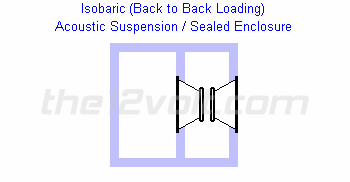
• Isobaric - Sealed (Back to Back)
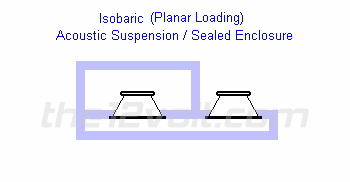
• Isobaric - Sealed (Planar Loading)
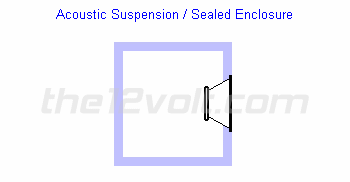
Acoustic Suspension / Sealed Enclosure
|

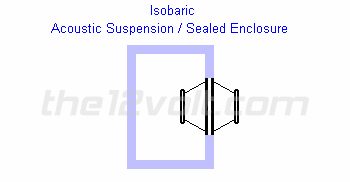
Isobaric - Acoustic Suspension / Sealed Enclosure
|
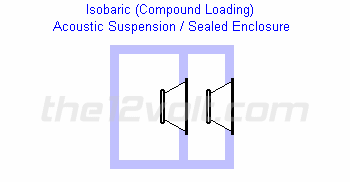
Isobaric - Acoustic Suspension / Sealed (Compound Loading) Enclosure
|
Isobaric - Acoustic Suspension / Sealed (Back to Back) Enclosure
|
Isobaric - Acoustic Suspension / Sealed (Planar Loading) Enclosure
|
| << Previous - Second Order / Infinite Baffle / Free Air | Next - Fourth Order / Bass Reflex & Bandpass Enclosures >> |
Subwoofers, Enclosures, & Calculators:
• Second Order / Infinite Baffle / Free Air• Second Order / Acoustic Suspension & Sealed Enclosures
• Fourth Order / Bass Reflex & Bandpass Enclosures
• Sixth & Eighth Order Enclosures
• Parallel & Series Calculators
• Subwoofer Enclosure Calculators
• Subwoofer Wiring Wizard
• Thiele - Small Parameters
Help and Additional Resources:
• Car Audio Forum• Car Audio Home
• Car Audio Hot Topics
• Car Audio Manuals
• Passive Crossovers
• Stereo to Bridged Mono Switched Outputs
• Switch Series to Parallel and Back
• Switch Stereo to Bridged Mono & Series to Parallel

| Search the12volt.com |

Tuesday, May 19, 2026 • Copyright © 1999-2026 the12volt.com, All Rights Reserved • Privacy Policy & Use of Cookies