








Subwoofer Enclosures, Fourth Order
 A fourth order enclosure (vented box) is a sealed enclosure with the additon
of a port tuned to a specific frequency. The port extends the low frequency response
of the basic sealed enclosure usually providing a lower cut-off frequency. The
enclosure offers a good transient response (second to that of a sealed enclosure),
good power handling within it's bandpass region, and excellent efficiency making it a
popular choice for many competitors and everday users, but
below the tuned frequency power handling is poor and damage to the woofer is likely
to occur if over driven. Lowering the port frequency below that of the manufacturer's recommended
frequency will only worsen matters and cause the sound to become "muddy"....bleah!
A fourth order enclosure (vented box) is a sealed enclosure with the additon
of a port tuned to a specific frequency. The port extends the low frequency response
of the basic sealed enclosure usually providing a lower cut-off frequency. The
enclosure offers a good transient response (second to that of a sealed enclosure),
good power handling within it's bandpass region, and excellent efficiency making it a
popular choice for many competitors and everday users, but
below the tuned frequency power handling is poor and damage to the woofer is likely
to occur if over driven. Lowering the port frequency below that of the manufacturer's recommended
frequency will only worsen matters and cause the sound to become "muddy"....bleah!
With any ported design enclosure, the largest port diameter or area should be used to minimize port noises (or whistling). Flaring the edges of the port is also recommended for the same reasons. Ports may be any shape, but a cyclinder is usually the easiest to incorporate into your design. These enclosures are obviously more complex to build, less forgiving of design errors, and usually larger than sealed enclosures, but if done properly, they can provide that additional output a competitor desires.
Fourth Order/Bass Reflex and Bandpass Enclosures:
• Fourth Order / Bass Reflex• Isobaric - Bass Reflex
• Isobaric - Bass Reflex (Compound Loading)
• Bass Reflex - Passive Radiator
• Isobaric Bass Reflex - Passive Radiator
• Single Reflex - Band Pass
• Isobaric Single Reflex Bandpass
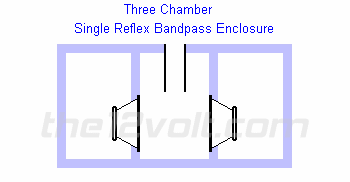
• Three Chamber Single Reflex Bandpass
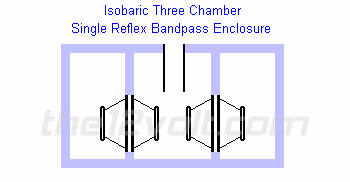
• Isobaric Three Chamber Single Reflex Bandpass
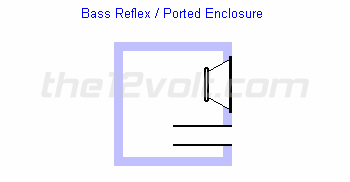
Fourth Order/Bass Reflex / Ported Enclsoure
|

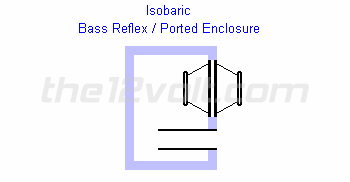
Isobaric - Bass Reflex / Ported Enclosure
|
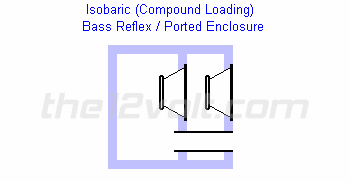
Isobaric - Bass Reflex (Compound Loading) / Ported Enclosure
|
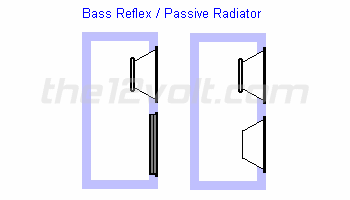
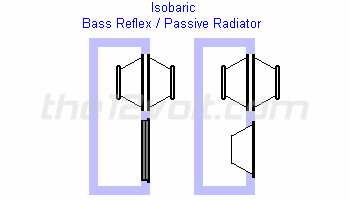
Bass Reflex - Passive Radiator Enclosures
|
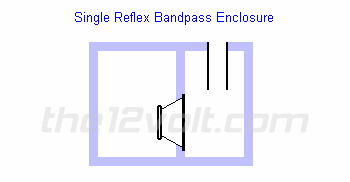
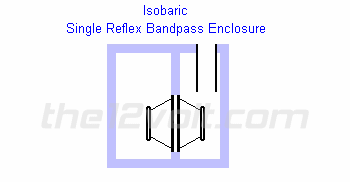
Single Reflex - Band Pass Enclosures
|
| << Previous - Second Order / Acoustic Suspension & Sealed Enclosures | Next - Sixth & Eighth Order Enclosures >> |
Subwoofers, Enclosures, & Calculators:
• Second Order / Infinite Baffle / Free Air• Second Order / Acoustic Suspension & Sealed Enclosures
• Fourth Order / Bass Reflex & Bandpass Enclosures
• Sixth & Eighth Order Enclosures
• Parallel & Series Calculators
• Subwoofer Enclosure Calculators
• Subwoofer Wiring Wizard
• Thiele - Small Parameters
Help and Additional Resources:
• Car Audio Forum• Car Audio Home
• Car Audio Hot Topics
• Car Audio Manuals
• Passive Crossovers & Calculators
• Stereo to Bridged Mono Switched Outputs
• Switch Series to Parallel and Back
• Switch Stereo to Bridged Mono & Series to Parallel

| Search the12volt.com |

Sunday, May 10, 2026 • Copyright © 1999-2026 the12volt.com, All Rights Reserved • Privacy Policy & Use of Cookies