








Rain or water sensor?
Home /
the12volt's Install Bay /
Car Security and Convenience / Rain or water sensor? ( Topic Closed)
Topic Closed) Members
 Search
 Register
 Login
Login


Posted: November 19, 2005 at 11:39 PM / IP Logged


Posted: November 20, 2005 at 1:19 PM / IP Logged
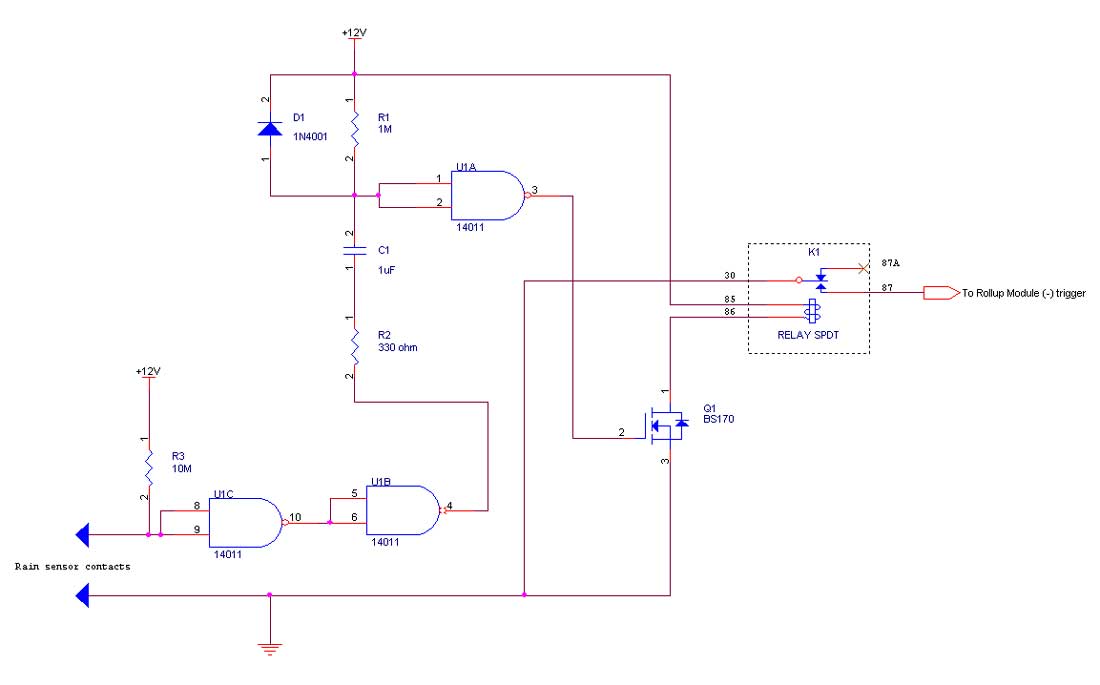 Component List >>>
1uF cap
1N4001 diode
RELAY
BS170
10M, 1M, 330 ohm resistors
14011 CMOS NAND gate
Maybe use a pair of header pins for the contacts, which you would put in a shallow tray that would collect the rain water- the idea is that when the water touches both pins, it'll conduct and short the two together, triggering the circuit and briefly closing the relay.
It outputs a single pulse, and won't repeat until the contacts dry out and open the circuit again.
Component List >>>
1uF cap
1N4001 diode
RELAY
BS170
10M, 1M, 330 ohm resistors
14011 CMOS NAND gate
Maybe use a pair of header pins for the contacts, which you would put in a shallow tray that would collect the rain water- the idea is that when the water touches both pins, it'll conduct and short the two together, triggering the circuit and briefly closing the relay.
It outputs a single pulse, and won't repeat until the contacts dry out and open the circuit again.Posted: November 20, 2005 at 1:23 PM / IP Logged
Posted: November 20, 2005 at 5:07 PM / IP Logged
Posted: November 20, 2005 at 9:17 PM / IP Logged

Posted: November 20, 2005 at 9:50 PM / IP Logged
Sorry, you can NOT post a reply.
This topic is closed.
 Printable version
| You cannot post new topics in this forum You cannot reply to topics in this forum You cannot delete your posts in this forum You cannot edit your posts in this forum You cannot create polls in this forum You cannot vote in polls in this forum |

| Search the12volt.com |
Follow the12volt.com 
Sunday, April 26, 2026 • Copyright © 1999-2026 the12volt.com, All Rights Reserved • Privacy Policy & Use of Cookies

Sunday, April 26, 2026 • Copyright © 1999-2026 the12volt.com, All Rights Reserved • Privacy Policy & Use of Cookies
Disclaimer:
*All information on this site ( the12volt.com ) is provided "as is" without any warranty of any kind, either expressed or implied, including but not limited to fitness for a particular use. Any user assumes the entire risk as to the accuracy and use of this information. Please
verify all wire colors and diagrams before applying any information.